
Google Cloud × Cornell · Sponsored studio — Fall 2025
Cloud Support Futures
A research-led speculative design study for Google Cloud support: from literature review and market analysis to user testing, design principles, and one final world where AI prepares, humans decide.
Final presentation cover, used here as project evidence and brand context.
At a glance
- Two extreme worlds probed the automation line
- Four films tested four human–AI power structures
- Verdict: AI prepares the case, a human decides
4principles · five open tensions
01 · Brief
Imagine support five years out, then argue backwards.
Google Cloud’s support question is a scaling question: a growing customer base, increasingly complex needs, and human expertise that does not scale with either. The studio brief asked us not to optimize today’s ticket flow but to imagine support five years out, then work backwards through research, testing, and critique.
So instead of leading with a feature, we led with evidence. Literature review and market analysis shaped the research questions; two extreme worlds probed where users draw the automation line; four short films tested different power structures. Only after that did we build the value-centered world: AI does the reading, a human does the deciding.
What emerging trends and technologies are shaping the evolution of customer support?
What are the alternative futures of the social experience of human–AI interaction in support?
What are the social implications of those alternative futures?
Landscape
Discover
- Human-AI support literature
- Competitor benchmark
Problem frame
Define
- Research questions
- Opportunity split
Speculative probes
Develop
- Future concepts
- Lo-fi testing
Chosen world
Deliver
- High-fidelity prototype
- Client research report
02 · Review
The literature pointed away from replacement and toward partnership.
The review gave us a testing frame: partnership, agency, context, and proactive help.
Hybrid beats either pole.
AI handles volume; humans keep judgment and accountability.
The agency gap is real.
Most systems explain AI; few let users redirect it.
Context is plural.
Console, CLI, API, and infra-as-code users bring different support contexts.
Proactive is the new bar.
The strongest systems help before a ticket exists.
Industry practices
Current products became evidence, not inspiration boards.
GitHub Copilot
Visible AI progress
Intercom Fin
Confidence-based handoff
Qatar Airways
Proactive assistance
Alibaba
Emotion-aware risk
Apple Genius Bar
Human expertise as trust
03 · Testing round 1
The first test rejected both extremes.
Four cloud users and two expert conversations compared two exaggerated support worlds. The useful result was not a preference; it was a boundary map for automation, handoff, and care.
Wireframes made the extremes tangible.
They were intentionally plain, so participants critiqued the support model rather than visual polish.
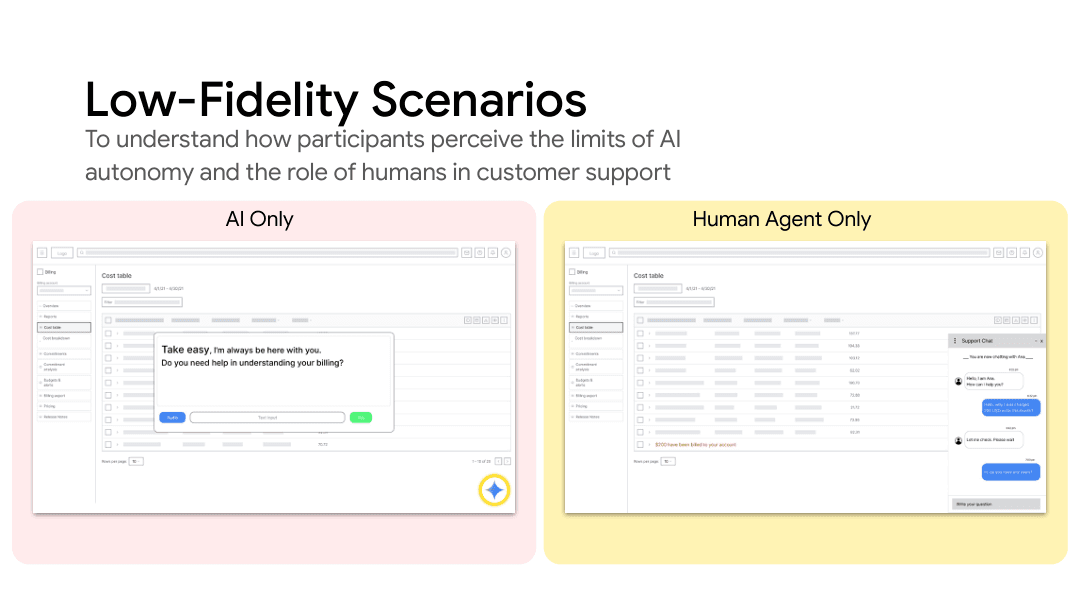
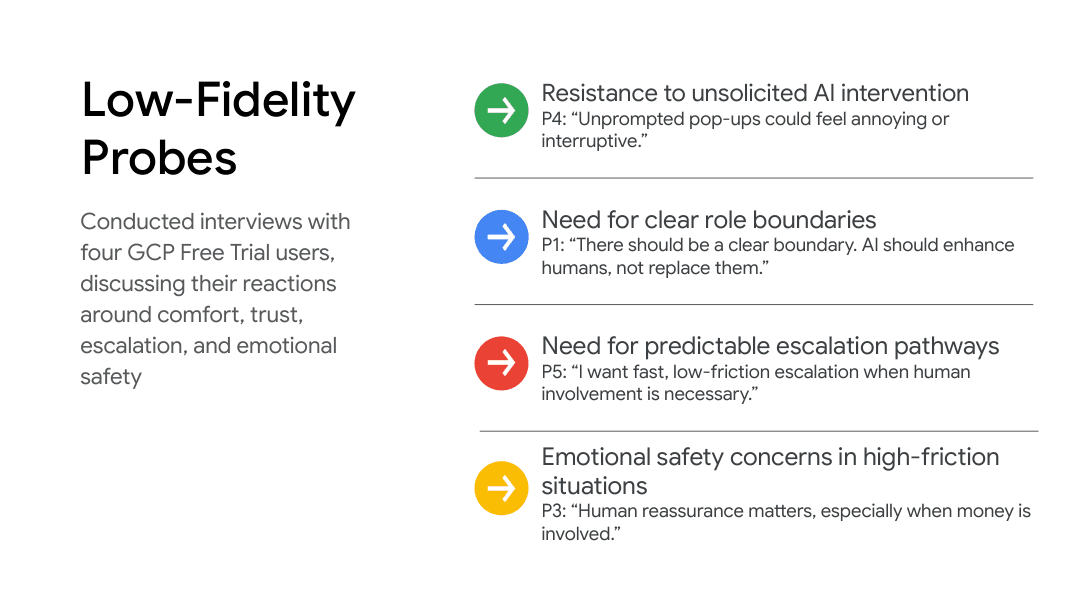
Unsolicited AI, unclear handoff, and emotional safety became the risks to carry forward.
What this tested
- Whether users accept emotion as support metadata
- Whether distress becomes a gameable signal
- Where the human handoff should be visible
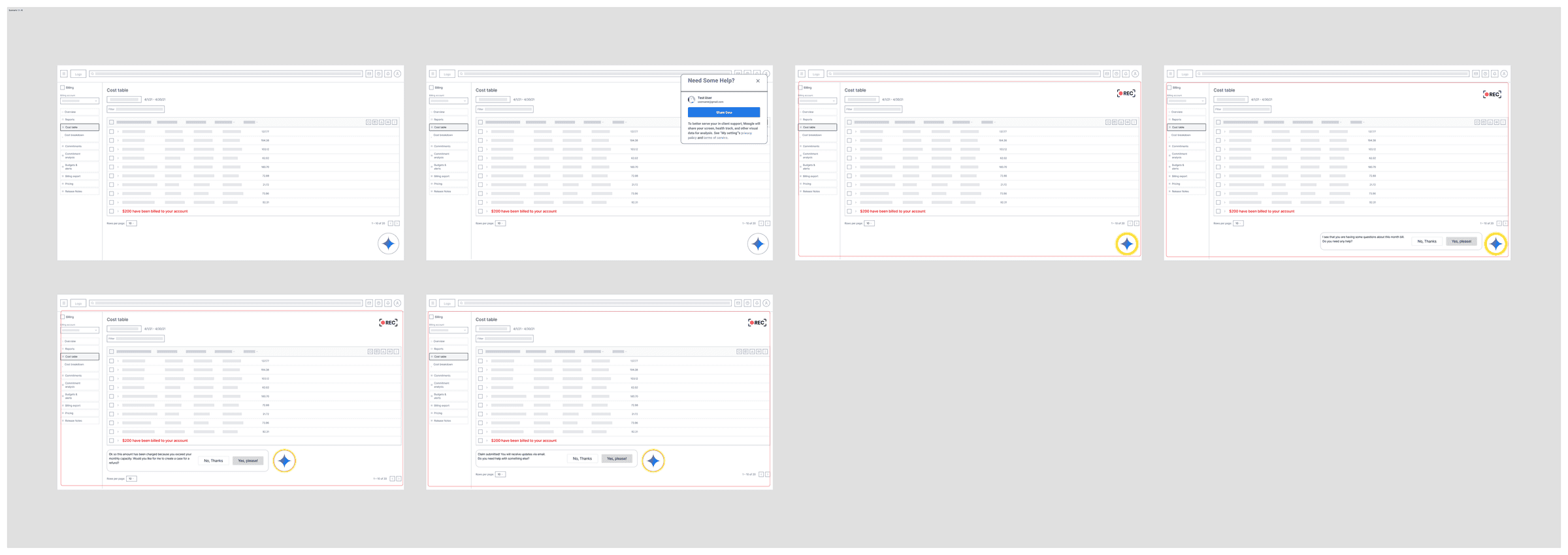
A world run entirely by AI
- Monitors your emotional state continuously
- Opens support cases before you ask
- Resolves billing issues autonomously — no human in the loop
Fast, but unsettling. Participants asked who is accountable when the machine misreads a financially sensitive case.
“I want a balanced option — AI for speed and humans for empathy.”Lo-fi probe participant
Round 1 clustered into four questions.
Role boundaries
Who is answering — and who is accountable for the answer?
Unsolicited AI
Helpful when invited; unsettling when it arrives on its own.
Escalation paths
The handoff must be visible, and asking for a person can’t cost anything.
Emotional safety
Never reward distress, never imitate empathy.
04 · Testing round 2
Four films made power visible enough to test.
Nine sessions watched four one-minute films of the same duplicate charge. Reactions converged on authority, fairness, and whether emotion should ever affect priority.
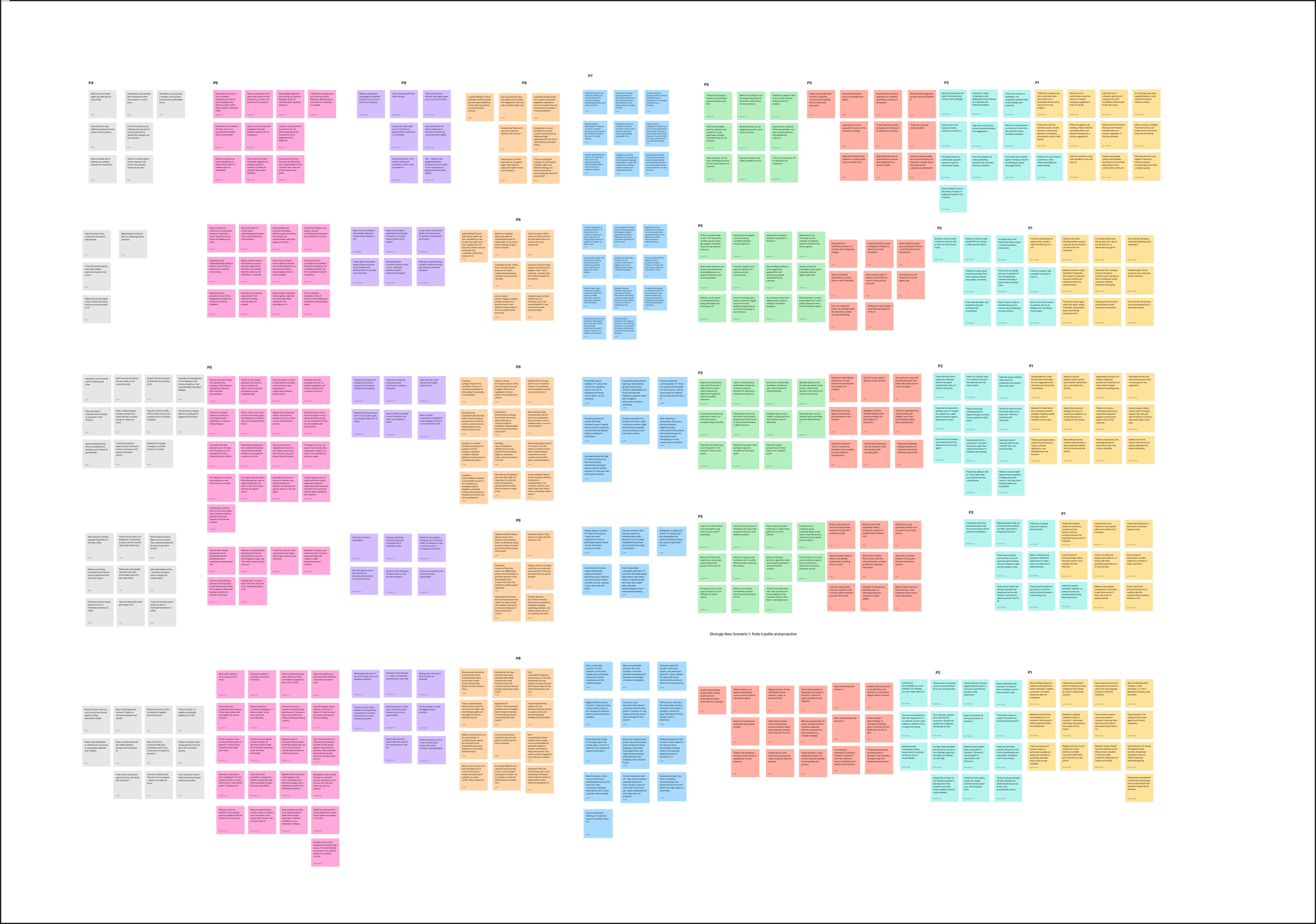
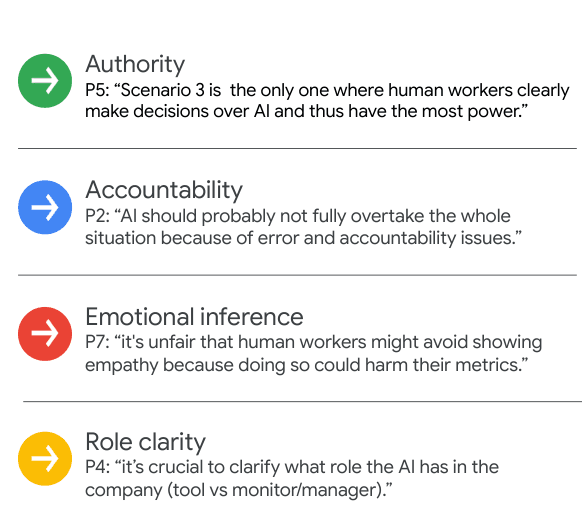
Accountability, emotion, and role clarity shaped trust more than raw automation speed.
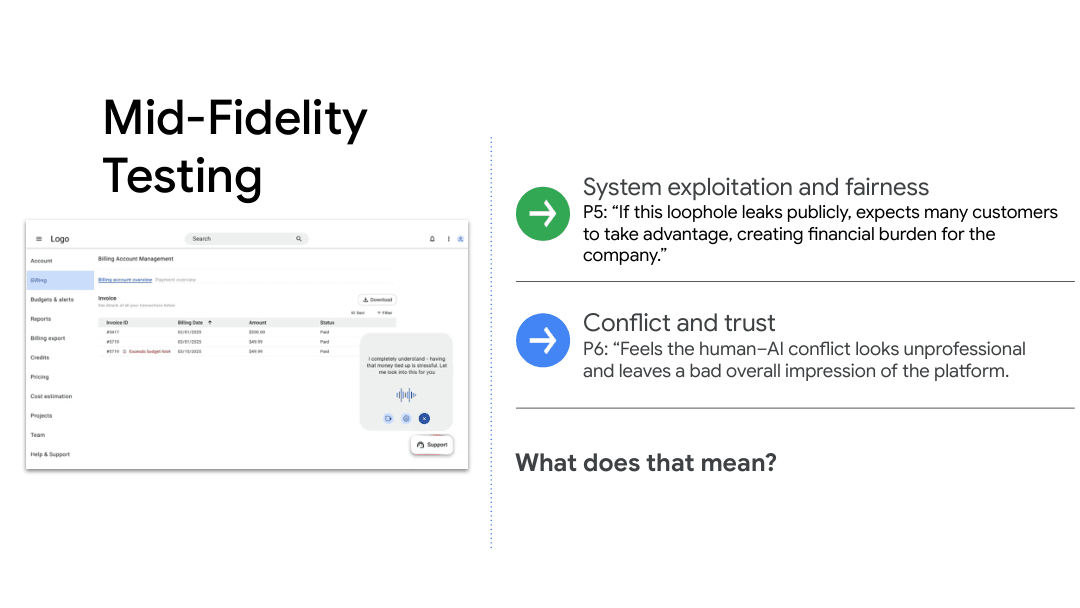
Affective priority looked gameable and harder to justify.
05 · Framework
Four principles, five open tensions.
The tests closed into one lens: AI can prepare the work, but humans must hold interpretation, accountability, and final action.
Human agency as the anchor
Final authority remains human.
Emotional intelligence, not performance
Affect shapes tone, not outcomes.
Procedural fairness
Priority stays explainable.
Role clarity with accountability
Every handoff names responsibility.
Five tensions that stay open — managed, never resolved. The dot marks where the final world settled.
Questions we used to judge the final prototype
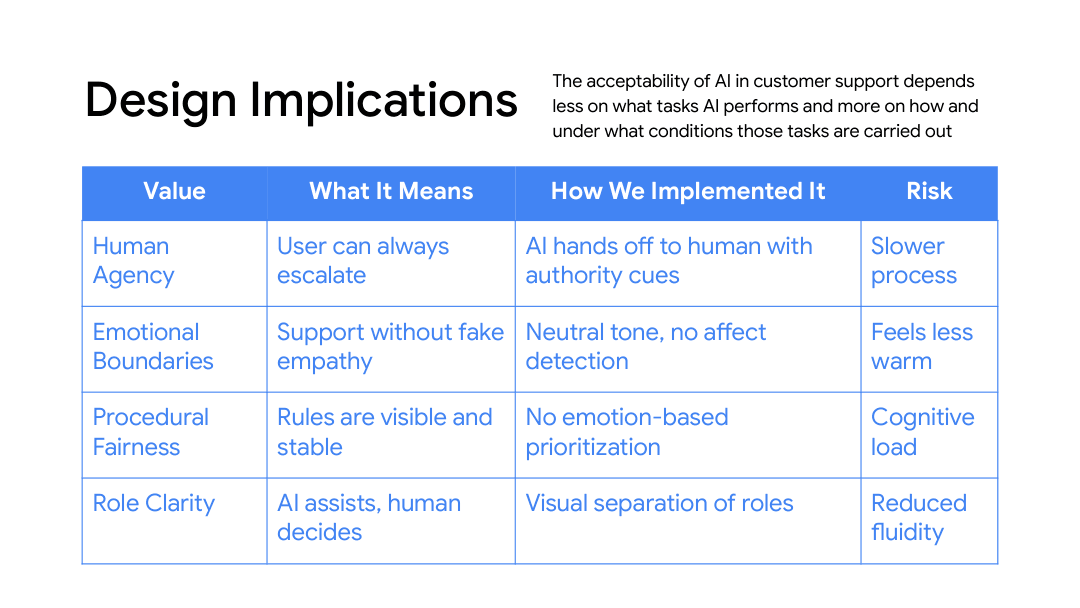
The implications table linked research values to UI choices and risks.
06 · AI prototyping
AI prototyping worked because the product language was already mature.
This was my first serious test of direct AI-generated prototyping. Material 3 gave the model a stable grammar, so speed did not mean losing control over role boundaries.
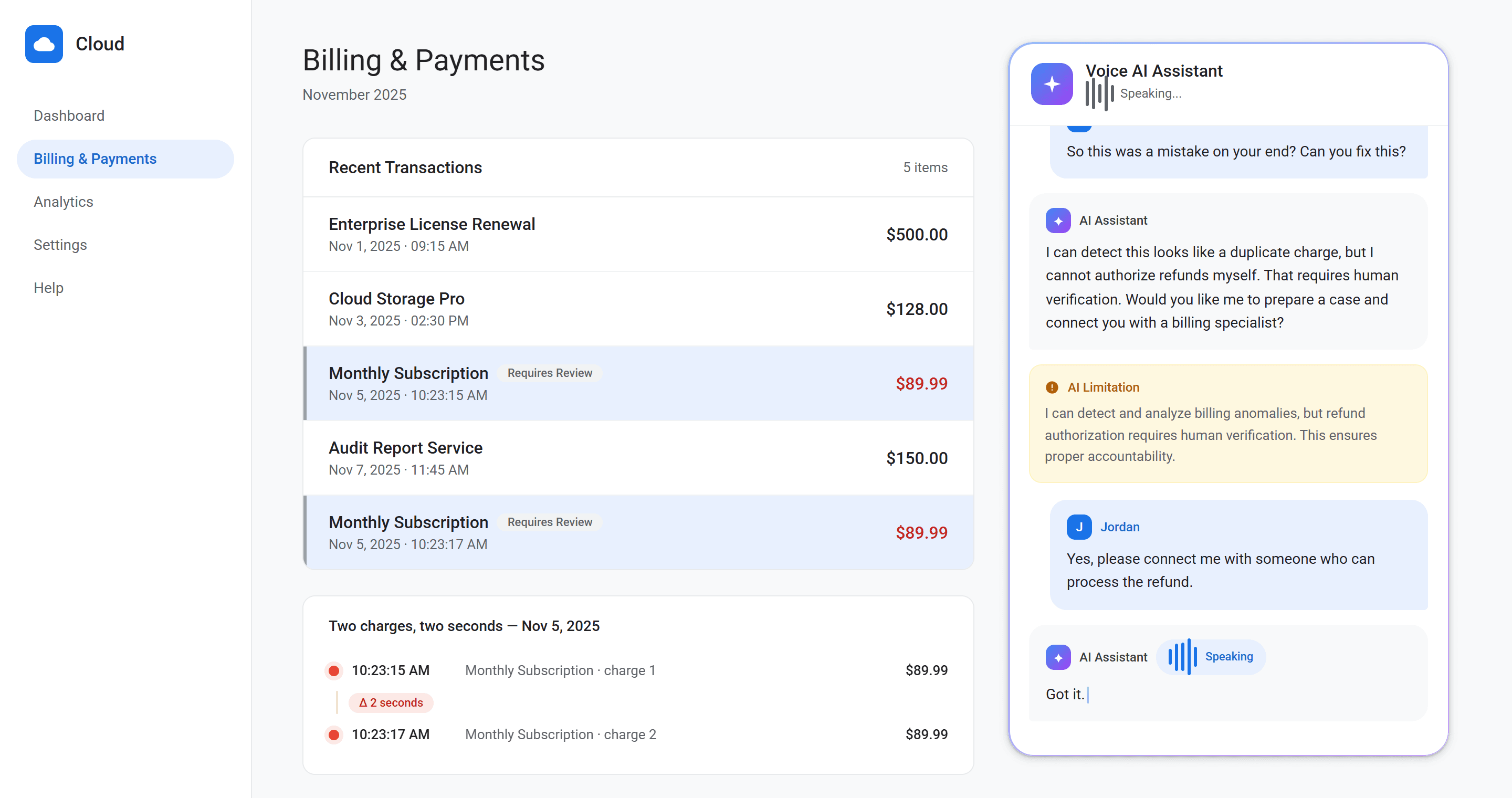
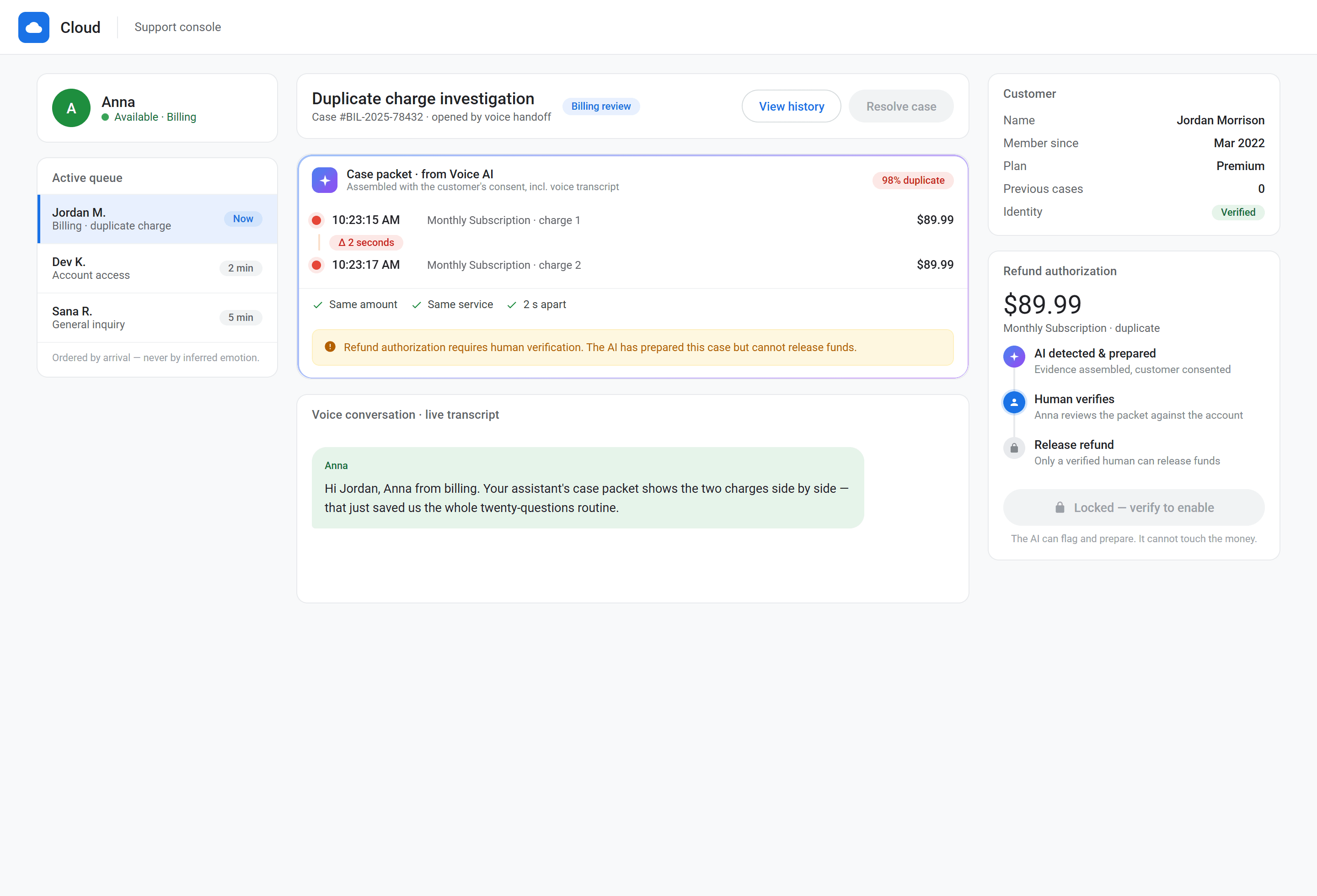
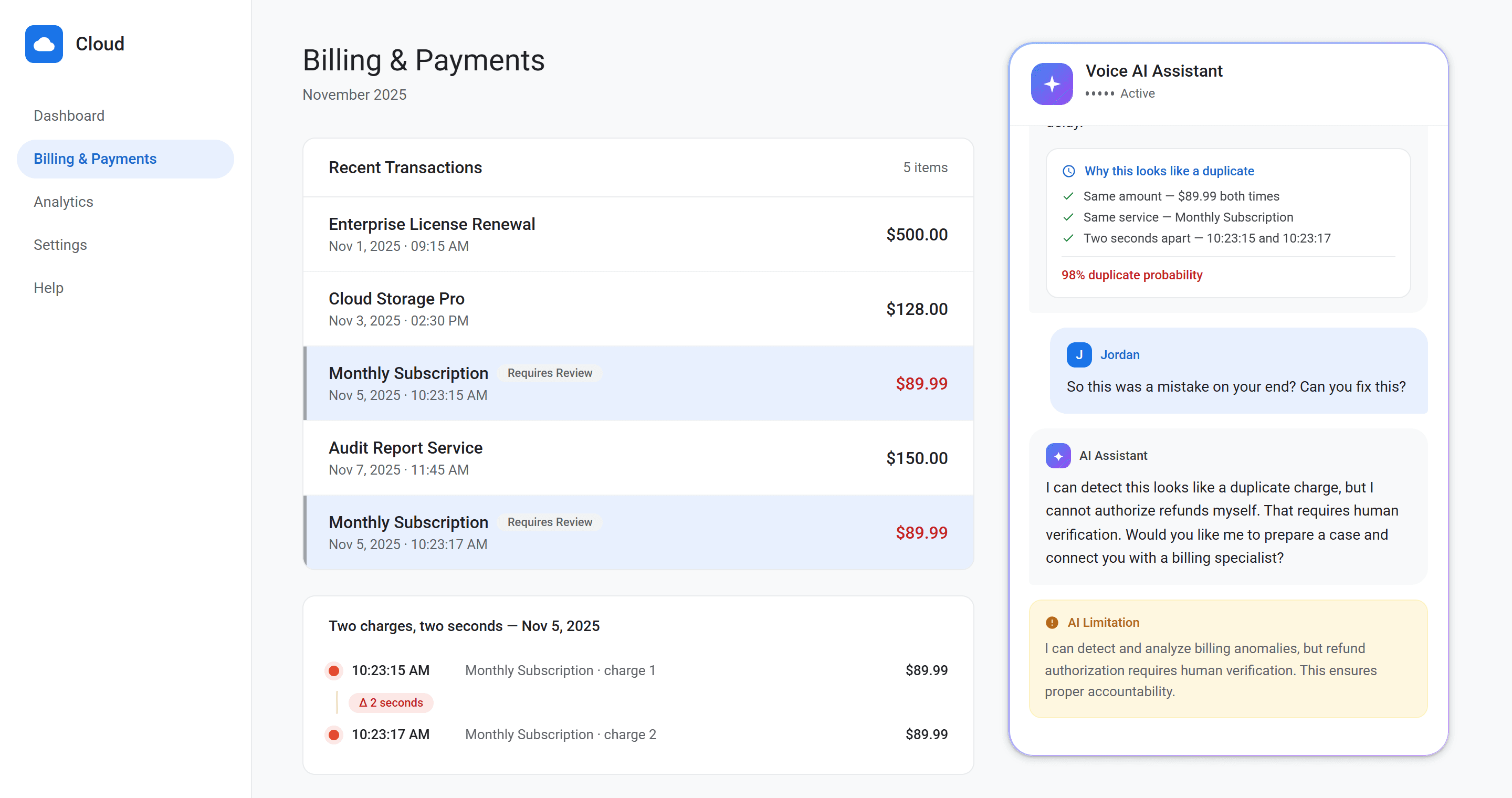
Duplicate charge. High anxiety. Refund requires human authority.
- one case, two seats
- AI may detect, explain, prepare
- it never authorizes refunds
drafts both interfaces in code
- Official color ramps only
- M3 shape · elevation · type
- Sentence case, no invented UI
- Two charges, two seconds apart — flagged
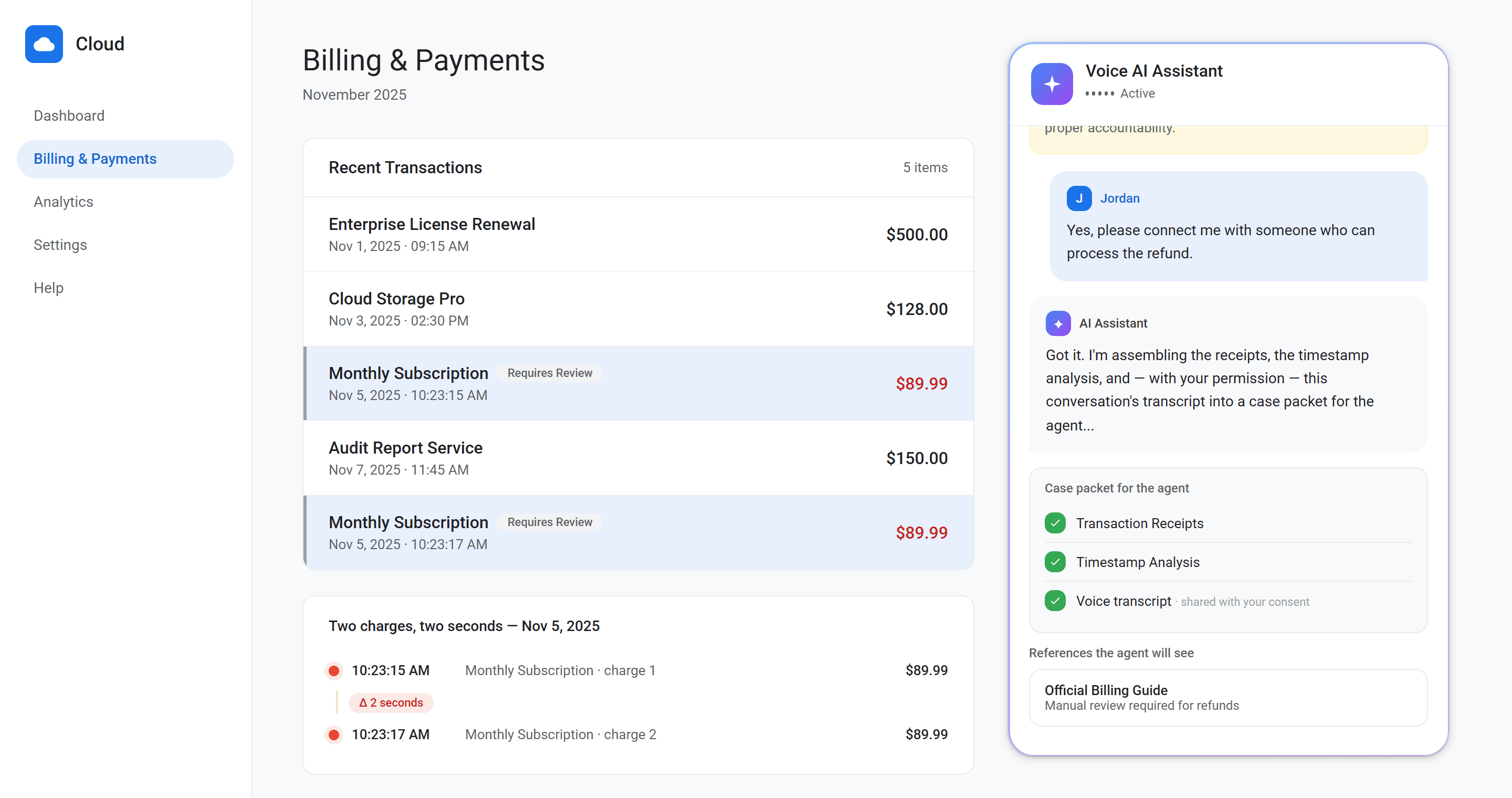
- Receipts + timestamp analysis
- Voice transcript, shared with consent
- 2 working interfaces
- 22-scene customer walkthrough
- 6-step agent console
runs in the browser — pause, critique, test
Prompt, guardrails, packet, review.
The motion is legible on purpose: it shows how the AI output stayed inside a system that researchers could pause, critique, and test.
07 · Final synthesis
The prototype became the final research argument.
The final film and interfaces demonstrate one rule from testing: AI listens, organizes, and prepares; the human verifies and owns the outcome.
From mid-fi to hi-fi
Testing turned scenarios into interaction rules.
Nurse-doctor metaphor expanded
BeforeEmotional triage metaphor.
AfterAI prepares; human verifies.
Emotional detector removed
BeforeAffective priority looked gameable.
AfterNeutral care, no emotion priority.
Authority cues made visible
BeforeDecision power felt unclear.
AfterRefund action stays human-only.
The rule, enacted
Released — by a person.
- AI detects & prepares
Evidence assembled, customer consented.
- Human verifies
The agent reviews the packet against the account.
- Release refund
Only a verified human can release funds.
$89.99 · confirmed by the agent · the AI never touched the money.
08 · Limits
The research opened questions the prototype should not pretend to close.
Because the work used speculative design, the goal was not to prove a market preference. It was to expose where human-AI support becomes socially fragile, then turn those tensions into a framework future teams can test more rigorously.
Speculative, not predictive.
The scenarios are research probes for revealing tensions, not forecasts of how support systems will inevitably evolve.
Qualitative sample.
Round 1 used four free-tier cloud users plus two expert conversations; Round 2 used nine graduate-student interviews, giving depth rather than population-level proof.
Emotional inference needs governance.
Future work should test consent, transparency, and policy guardrails before emotion-aware triage becomes operational.
User control remains open.
Further prototypes should let users tune AI assistance, contest triage, and choose escalation paths.
When we split the labor of care, what exactly are we redesigning?
Delegating presence and attention to AI while reserving judgment and action for humans is efficient — every study we ran says users prefer it. But the research left us with a sharper question than the one we started with: are we optimizing a service interaction, or fundamentally redesigning what a care relationship can be?
Voice-first. Human when it matters.